
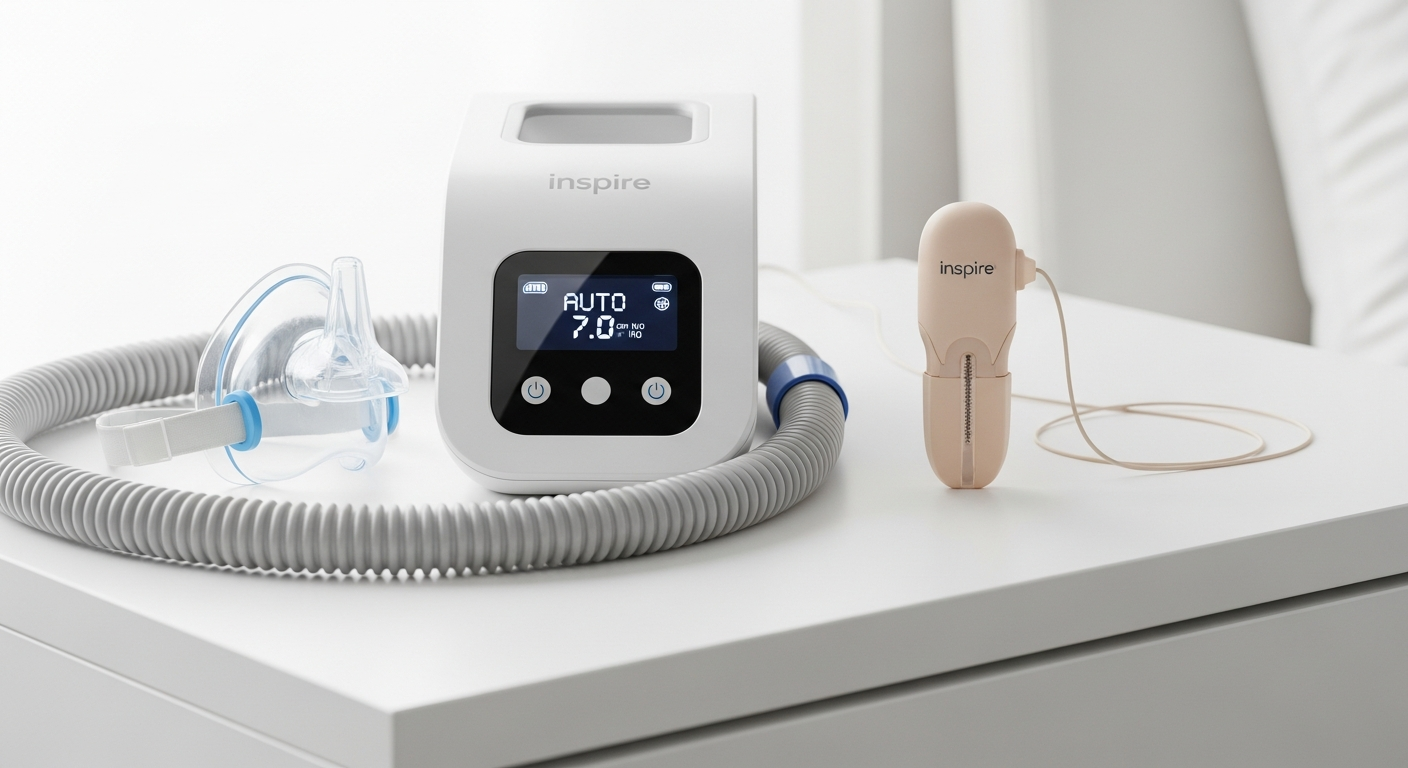
The CPAP Machine in Your Closet
Let's talk about the elephant in the room. Or rather, the CPAP machine in your closet.
Your doctor prescribed it six months ago. You tried it for two weeks. The mask didn't fit right. The air pressure felt suffocating. You woke up with dry mouth every morning. Your partner said the noise was annoying. And now it's sitting in your closet, still in the box, mocking you every time you walk past.
Sound familiar?
You're not alone. Up to 50% of people prescribed CPAP struggle to use it consistently. If you're one of them, you're not a failure. You're just human.
The good news? CPAP isn't your only option.
Why CPAP Is So Hard for So Many People
Before we dive into alternatives, let's be honest about why CPAP fails for so many people.
The Comfort Issues
The mask never fits quite right. You're either getting air leaks (annoying high-pitched whistling at 2am) or it's strapped so tight you have marks on your face in the morning.
Dry mouth and nose. Even with the humidifier setting cranked up, you wake up feeling like you swallowed a bag of sand.
Claustrophobia. Some people just can't handle having something strapped to their face all night. It triggers panic, not sleep.
Skin irritation. Red marks, pressure sores, rashes where the mask sits. Attractive and uncomfortable.
The Lifestyle Challenges
Traveling with CPAP is a pain. Extra bag to carry. Needs power. Needs distilled water. TSA questions. Hotel room outlet locations. It's exhausting.
Partner disturbance. The whooshing noise, the air leaks, the mask readjustments at 3am — your partner might actually prefer the snoring.
The psychological burden. Feeling "dependent" on a machine. The embarrassment. The constant reminder that you have a medical condition.
Medical Complications Some People Experience
Aerophagia (swallowing air) that leads to bloating and gas. Not fun.
Sinus infections from the pressure and humidity.
Nosebleeds from dry air or pressure.
So if CPAP isn't working for you, what else is there?
What Makes You "CPAP Intolerant"?
Before exploring alternatives, you should know: in Singapore, you're generally considered CPAP-intolerant if you:
- Can't use CPAP for at least 4 hours per night
- Have tried for 3-6 months with mask adjustments and pressure changes
- Have documented side effects or complications
This matters because insurance companies often require proof of CPAP failure before covering alternative treatments. So document everything. Keep records.
Alternative #1: Inspire — The "Pacemaker for Your Airway"
This is the most exciting development in sleep apnea treatment in decades.
What Is Inspire?
Imagine a tiny device implanted under your skin (like a pacemaker) that stimulates your tongue nerve to keep your airway open while you sleep. That's Inspire.
You control it with a small remote. Click it on before bed, click it off when you wake up. No mask. No hose. No noise.
How It Actually Works
The device has three parts:
- Sensing lead detects when you breathe in
- Stimulation lead activates your hypoglossal nerve
- Generator coordinates everything (sits under your collarbone)
When you breathe in during sleep, the device gently stimulates your tongue muscles. Your tongue moves forward slightly. Your airway stays open. You breathe normally.
You don't feel it. Your partner doesn't hear it. You just... sleep.
Am I a Candidate?
Inspire is picky about who qualifies. You need:
- Moderate to severe OSA (AHI between 15-65)
- Documented CPAP intolerance (this is why documentation matters)
- BMI under 35 (sorry, but outcomes are poor above this)
- No concentric collapse on DISE (drug-induced sleep endoscopy — a test they do to see how your airway collapses)
The Cost Reality
Inspire costs $50,000-$70,000 in Singapore. Yes, that's a lot. But:
- Some insurance plans cover it (if you're CPAP-intolerant)
- It lasts 10-12 years
- No ongoing supply costs (unlike CPAP)
Do the math on 10 years of CPAP supplies and it starts to make more sense.
The Results
The data is impressive:
- 79% reduction in AHI on average
- 90% of bed partners report no more snoring
- 94% of patients satisfied at 5 years
This isn't experimental — it's proven and FDA-approved.
Alternative #2: Upper Airway Surgery
Surgery isn't sexy. But sometimes it's the right answer.
UPPP (Uvulopalatopharyngoplasty)
This is the most common sleep apnea surgery. The surgeon removes excess tissue from your soft palate and throat to widen the airway.
Success rate: 40-60% reduction in AHI Cost in Singapore: $13,700-$21,600 (private hospitals) Recovery: 2-3 weeks of throat pain (think severe tonsillitis)
It works best for people whose obstruction is mainly at the palate level.
MMA (Maxillomandibular Advancement)
This one is more invasive but crazy effective. Both jaws are moved forward to permanently enlarge your airway.
Success rate: 85-90% reduction in AHI Cost: $40,000-$70,000 Recovery: 4-6 weeks, significant swelling
Yes, your face will look slightly different after. Often considered an improvement (more defined jawline). But it's still surgery that changes your facial structure.
Multi-Level Surgery
Some people need procedures at multiple sites:
- Nose (septoplasty, turbinate reduction)
- Palate (UPPP or other procedures)
- Tongue base (reduction or suspension)
- Hyoid bone (suspension)
The surgeon uses DISE (drug-induced sleep endoscopy) to map exactly where your airway collapses, then fixes all those sites.
The advantage: Addresses all your obstruction points at once The disadvantage: More invasive, longer recovery, higher cost
Alternative #3: Oral Appliances — The Simple Solution
For some people, the solution is surprisingly low-tech.
Mandibular Advancement Devices (MAD)
Custom-fitted dental devices that hold your lower jaw forward during sleep. This pulls your tongue forward and keeps your airway open.
Pros:
- Non-invasive (no surgery)
- Portable (fits in your pocket — great for travel)
- Relatively affordable ($2,000-$4,000)
- No electricity needed
Cons:
- Less effective than CPAP for severe OSA
- Can cause jaw pain or bite changes
- Requires regular dental follow-up
- Takes time to adjust to
Best for:
- Mild to moderate OSA
- People who travel frequently
- CPAP-intolerant patients not ready for surgery
It's not a cure-all, but for the right person, it's life-changing.
Alternative #4: Weight Loss
Let's address this directly: if you're overweight, losing 10-15% of your body weight can significantly improve sleep apnea. Some people achieve complete resolution.
The Reality Check
Weight loss works. The research is clear.
But: Weight loss takes time. And your sleep apnea is damaging your health right now. Most doctors recommend using CPAP or another treatment while you're working on weight loss, not instead of it.
Weight Loss Options in Singapore
Lifestyle modification — Diet, exercise, behavior change. Hardest but most sustainable.
Medically supervised programs — With doctors, dietitians, and accountability.
Bariatric surgery — For severe obesity, this can be life-changing. And insurance sometimes covers it.
Alternative #5: Positional Therapy
Some people only have sleep apnea when sleeping on their back. If that's you, positional therapy might help.
The Solutions
Low-tech: Sew a tennis ball into the back of your pajamas. Seriously. It works by making back-sleeping uncomfortable.
Medium-tech: Special pillows and positioning devices that keep you on your side.
High-tech: Vibrating devices that detect when you roll onto your back and gently vibrate to encourage position change.
The Limitation
This only works if you have positional OSA (about 25-30% of sleep apnea patients). You need a sleep study to confirm this.
How Do You Actually Choose?
With all these options, how do you decide?
Step 1: Get Proper Diagnosis
Make sure you have:
- Recent sleep study (within 2 years) showing your AHI, oxygen levels, sleep position data
- DISE (drug-induced sleep endoscopy) if you're considering surgery
- Documented CPAP trial with evidence of intolerance
Step 2: Find the Right Specialist
Not all ENT doctors specialize in sleep surgery. Look for:
- Fellowship training in sleep medicine
- Experience with Inspire implantation (if interested)
- Multi-disciplinary approach (works with sleep physicians, not just surgical solutions)
Step 3: Understand Your Anatomy
DISE reveals exactly where your airway collapses:
- Palate collapse → UPPP might work
- Tongue base collapse → Inspire or tongue procedures
- Circumferential collapse → Might need MMA
- Multiple sites → Multi-level surgery
Step 4: Consider Your Life
Frequent traveler? Oral appliance or surgery makes sense. Inspire is okay (no supplies), but you still have the implant.
BMI over 35? Focus on weight loss first. Combine with CPAP if possible. Surgery outcomes are poorer at higher BMIs.
Young and active? More surgical options available. Better healing. Worth considering permanent solutions.
What About Insurance?
MediSave
Sleep surgery is generally MediSave claimable:
- UPPP: Up to $4,900
- Other procedures: $2,450-$4,500 depending on complexity
Private Insurance
Coverage varies wildly:
- Most require documented CPAP failure
- Pre-authorization is usually needed
- Some plans exclude "elective" sleep surgery (even though it's medically necessary)
- Inspire coverage depends on the plan
Get pre-authorization in writing before committing.
The Honest Truth About Alternatives
None of these alternatives are perfect. Each has trade-offs:
Inspire: Expensive, requires surgery, not for everyone, but incredibly effective for the right candidates.
Surgery: Can be highly effective, but recovery is rough, and there's no guarantee.
Oral appliances: Easy and portable, but less effective for severe OSA.
Weight loss: Works great but takes time you might not have.
Positional therapy: Only works for positional OSA.
The best treatment is the one you'll actually use consistently. That's the real metric.
Make a Decision and Commit
CPAP is the gold standard for a reason — it works for most people. But if you genuinely can't tolerate it after a real, sustained effort, don't beat yourself up.
Explore alternatives. Talk to a sleep specialist who knows all the options (not just surgery, not just CPAP). Get proper testing. Make an informed decision.
Untreated sleep apnea will kill you eventually. Heart disease, stroke, diabetes, car accidents — the risks are real.
Treated sleep apnea? You get your life back. Better sleep. More energy. Healthier heart. Sharper mind.
Whatever treatment you choose, the goal is the same: actually treating your sleep apnea.
Ready to explore your options beyond CPAP? Time to talk to a sleep specialist who understands the full range of solutions.