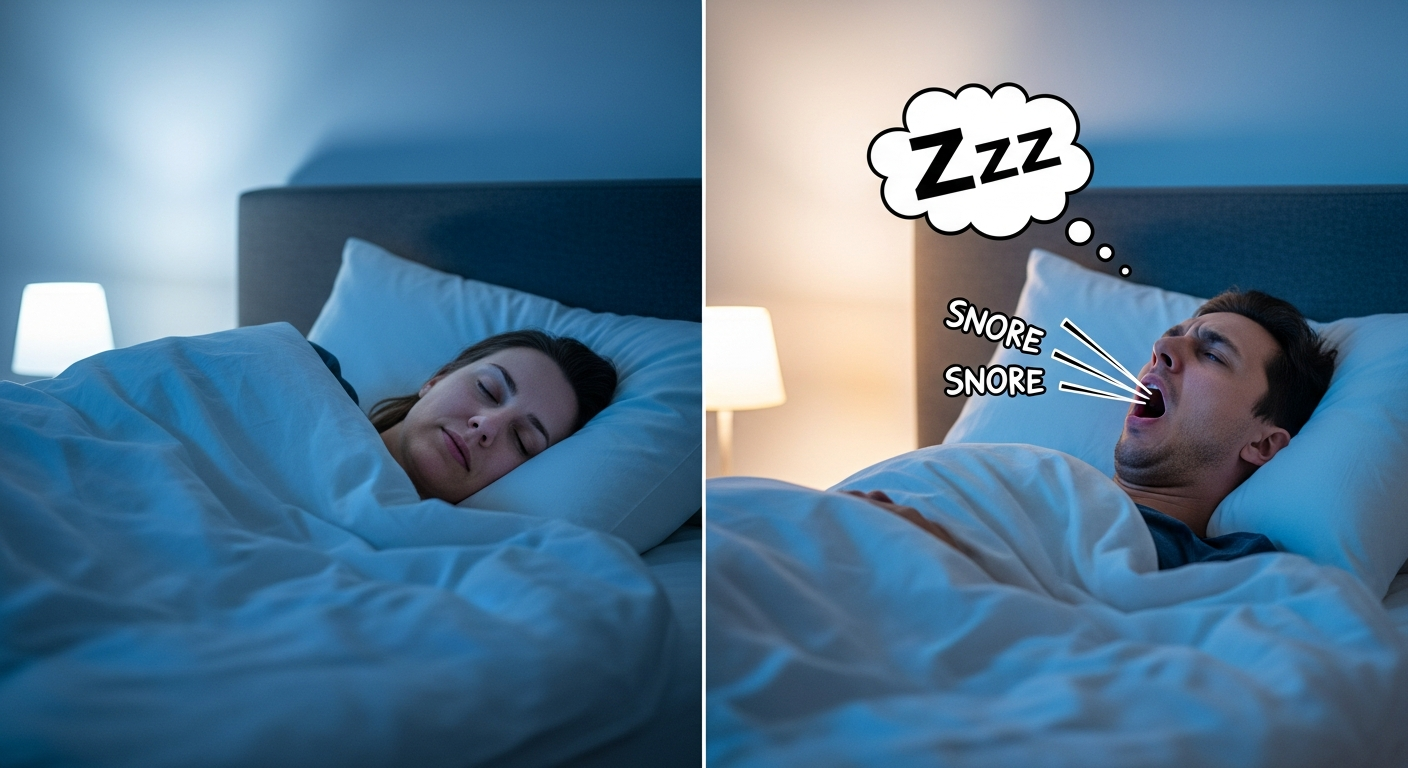

Your Partner Has Stopped Complaining About Your Snoring
Wait — that's not good news. They stopped complaining because they moved to the spare bedroom three months ago.
Or maybe they're still in the same room but wearing earplugs and fantasizing about hotels with sound-proof walls.
Here's what most people don't realize: loud snoring isn't just annoying. It might be a sign that you're literally stopping breathing dozens of times every night.
Welcome to sleep apnea, the silent health threat affecting about 15% of Singaporeans. Most don't even know they have it.
The Symptoms Everyone Notices (Except You)
Your Partner Sees It First: Witnessed Breathing Pauses
This is the big one. If your partner has ever said, "You stop breathing in your sleep," that's not something to brush off.
Here's what they're witnessing: You're snoring away. Then suddenly... silence. Ten seconds. Twenty seconds. Thirty seconds (they're starting to panic now). Then you gasp, choke, snort — and start breathing again.
This can happen dozens or even hundreds of times per night.
You don't remember any of it. But your brain does. It's waking you up slightly every time to restart your breathing. That's why you're exhausted even after "8 hours of sleep."
The Snoring That Wakes the Neighbors
Not all snoring is sleep apnea. But sleep apnea always involves snoring.
Warning signs your snoring is dangerous:
- Interrupted by pauses — Snore, silence, gasp, repeat
- Gasping or choking sounds — Your body desperately trying to breathe
- So loud it disturbs others — If your partner moved to another room, take note
Regular snoring sounds like a chainsaw. Sleep apnea snoring sounds like a chainsaw that keeps stalling and restarting.
The Restless Sleep Nobody Mentions
You're tossing and turning all night. Waking up tangled in sheets. Finding yourself in weird positions.
Why? Because your body is fighting to breathe. You're subconsciously moving, adjusting, trying to open your airway.
Add to that:
- Night sweats (your body is working hard)
- Frequent bathroom trips (sleep apnea affects hormones that regulate urination)
- Waking up with your heart racing
The Daytime Symptoms You've Been Ignoring
The Exhaustion That Coffee Can't Fix
You slept 8 hours. Why are you exhausted?
Because you didn't actually sleep. Your brain was partially waking up every time you stopped breathing. Your oxygen levels were dropping. Your heart was working overtime.
Red flags:
- Struggling to stay awake in meetings — Even important ones
- Falling asleep watching TV — Within minutes of sitting down
- Drowsy driving — This one can kill you and other people
- Need multiple naps just to function
This isn't "I'm getting older" or "work is stressful." This is pathological sleepiness. Your body is screaming for help.
The Brain Fog You Can't Shake
Difficulty concentrating. You read the same paragraph three times and still don't know what it said.
Memory problems. "Wait, what were we just talking about?"
Irritability and mood changes. Everything annoys you. Your fuse is short.
Decreased productivity. Tasks that used to take an hour now take three.
Your brain needs sleep to function. Sleep apnea is literally starving your brain of oxygen and proper rest.
The Morning Symptoms That Seem Random
Waking up with headaches. Your oxygen levels dropped overnight. Your brain is not happy about it.
Dry mouth or sore throat. You were mouth-breathing and gasping all night.
Feeling unrefreshed. You just "slept" 8 hours and feel like you didn't sleep at all.
Who's at Risk? (Probably You)
Physical Risk Factors
Obesity is the biggest risk factor. Extra weight around your neck literally compresses your airway. If your BMI is over 30, pay attention.
Neck circumference matters too:
- Men: Over 43cm (17 inches)
- Women: Over 38cm (15 inches)
Thick neck = higher risk.
Your anatomy:
- Large tonsils (even as an adult)
- Narrow throat
- Deviated septum
- Receding chin
- Large tongue
Some people are just built in a way that makes sleep apnea more likely. It's not fair, but it's biology.
Age increases risk, especially after 40. Throat muscles get weaker, tissue gets floppier.
Gender plays a role. Men are 2-3 times more likely than women to have sleep apnea. (Women, you catch up after menopause, so don't get too comfortable.)
Lifestyle Risk Factors You Can Actually Control
Alcohol relaxes your throat muscles, making obstruction worse. That nightcap might be killing your sleep quality.
Smoking increases inflammation and fluid retention in your airway. Smokers are 3 times more likely to have OSA.
Sleeping position matters. Sleeping on your back lets gravity collapse your airway. Side sleeping often helps.
Medical Conditions That Increase Risk
If you have any of these, you're more likely to have sleep apnea:
- High blood pressure (especially if it's hard to control)
- Type 2 diabetes
- Heart disease
- History of stroke
- PCOS (in women)
- Hypothyroidism
Take This Quick Self-Test: The Epworth Sleepiness Scale
Rate how likely you are to doze off in these situations (0 = never, 3 = high chance):
- Sitting and reading
- Watching TV
- Sitting inactive in a public place (like a theater)
- As a passenger in a car for an hour
- Lying down to rest in the afternoon
- Sitting and talking to someone
- Sitting quietly after lunch (no alcohol)
- In a car stopped for a few minutes in traffic
Total your score:
- 0-7: Normal
- 8-9: Mildly sleepy
- 10-15: Moderately sleepy
- 16-24: Severely sleepy
Score of 10 or higher? You should get evaluated for sleep apnea.
The Singapore Reality Nobody Talks About
The "Kiasu" Culture Problem
Singaporeans are pros at dismissing symptoms:
"Everyone is tired — it's just the work culture." "Of course I snore — I'm stressed." "I'll rest when the project is finished."
Meanwhile, untreated sleep apnea is:
- Increasing your heart attack risk by 30%
- Increasing your stroke risk by 60%
- Contributing to diabetes, depression, and cognitive decline
This isn't "just being tired." This is a medical condition slowly destroying your health.
The Driving Risk You're Taking
Severe untreated sleep apnea may affect your driving license eligibility in Singapore. More importantly, drowsy driving causes 20% of serious accidents.
Falling asleep behind the wheel isn't just a risk to you. It's a risk to everyone on the road.
The Workplace Impact You're Not Seeing
Studies show sleep apnea reduces productivity equivalent to missing 2 weeks of work per year.
The cognitive impairment is similar to being legally drunk. Imagine trying to do your job after three beers. That's your baseline with untreated OSA.
When to Actually See a Doctor
Stop ignoring this. See a sleep specialist if you have:
- Loud, frequent snoring (ask your partner)
- Witnessed breathing pauses (this is critical)
- Excessive daytime sleepiness (Epworth score over 10)
- BMI over 30 with any sleep symptoms
- High blood pressure that's hard to control
- A partner who can't sleep because of your snoring
Don't wait until you have a heart attack or stroke to take this seriously.
How Sleep Apnea Is Diagnosed
You can't self-diagnose sleep apnea. You need testing.
Home Sleep Test (HST)
You wear a device at home overnight. It measures:
- Breathing patterns
- Oxygen levels
- Heart rate
- Body position
Pros: Convenient, sleep in your own bed Cons: May miss mild cases Cost: $300-$500
In-Lab Polysomnography (PSG)
You sleep overnight in a sleep lab with comprehensive monitoring:
- Brain waves
- Eye movement
- Muscle activity
- Heart rhythm
- Breathing
- Oxygen saturation
Pros: Most accurate, can diagnose other sleep disorders Cons: Sleeping in a lab is weird Cost: $800-$1,500
The Results That Matter
AHI (Apnea-Hypopnea Index) = number of breathing interruptions per hour
- Less than 5: Normal
- 5-15: Mild OSA
- 15-30: Moderate OSA
- Over 30: Severe OSA
Even "mild" sleep apnea can have significant health impacts. Don't dismiss it just because it's not "severe."
The Bottom Line: Don't Ignore the Signs
Sleep apnea is one of the most underdiagnosed conditions in Singapore. Most people with it have no idea.
But here's the good news: it's highly treatable. CPAP, oral appliances, surgery, lifestyle changes — there are options that work.
The first step is admitting you might have a problem. The second step is getting tested. The third step is actually treating it.
Your snoring isn't just annoying. Your exhaustion isn't just stress. Your brain fog isn't just aging.
It might be sleep apnea. And sleep apnea is slowly, quietly damaging your health.
If you recognized yourself in these symptoms, don't wait. Talk to a sleep specialist. Get tested. Get treated.
Your body will thank you. Your partner will definitely thank you. And you might just save your own life.