
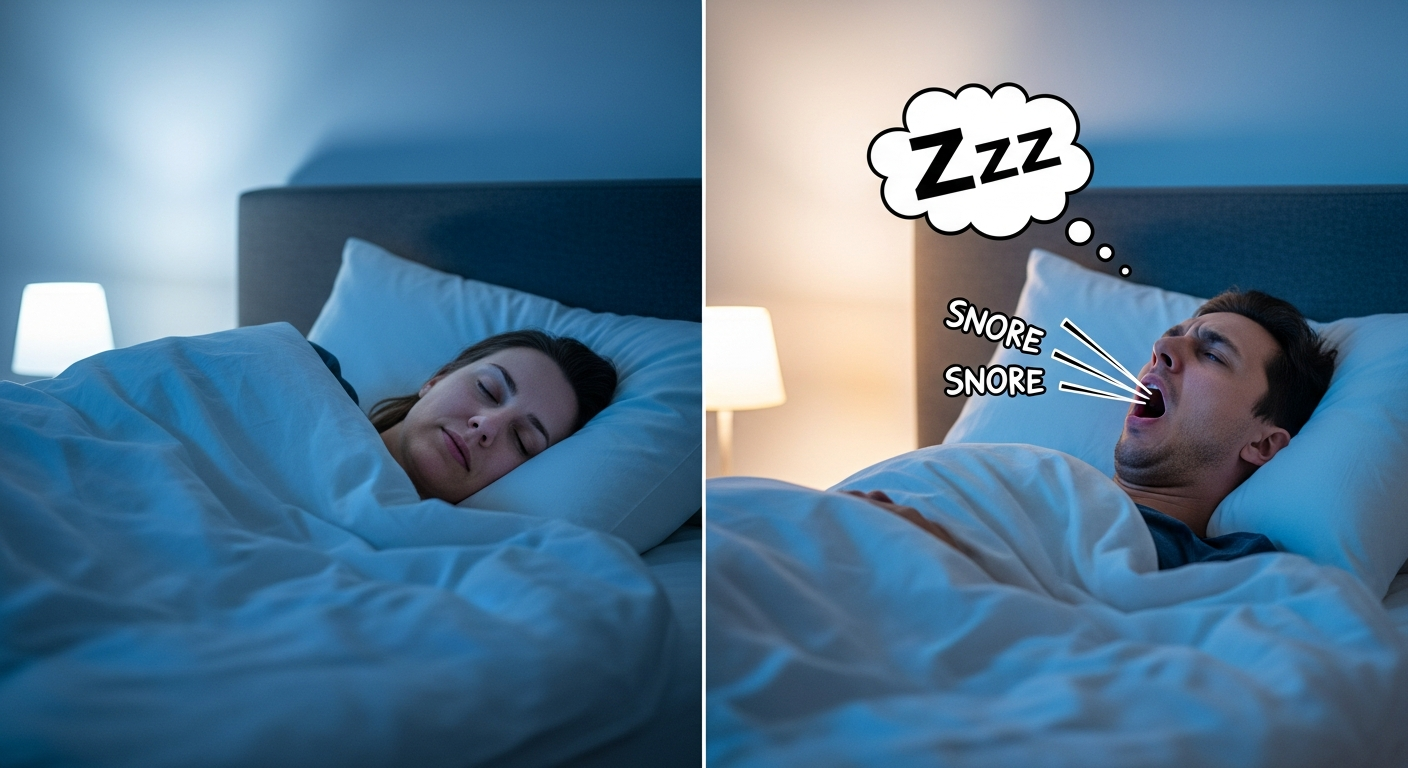
Your Partner Says You Snore. Should You Care?
About 40% of adults in Singapore snore. Most of them dismiss it with "everyone snores" or "it's just because I'm tired."
Sometimes they're right. Sometimes snoring is just snoring — annoying background noise with no real health implications.
But sometimes — and this is the part people miss — snoring is your body's way of screaming that you're literally stopping breathing dozens of times every night.
The trick is knowing which one you're dealing with.
What Is "Simple Snoring"?
Simple snoring (also called primary snoring) is noisy breathing during sleep without significant health consequences.
What it sounds like:
- Relatively steady rhythm
- No interruptions or pauses
- Maybe louder when you sleep on your back
- Annoying, but consistent
What it feels like (for you):
- You wake up feeling reasonably rested
- No excessive daytime sleepiness
- Normal energy levels
- Maybe your throat is a bit dry in the morning
Why it happens:
- Nasal congestion
- Alcohol before bed (relaxes throat muscles)
- Sleeping on your back
- Mild tissue vibration in your throat
- Age-related muscle relaxation
Simple snoring is mostly a quality of life issue. Your partner can't sleep. You might be embarrassed. But it's not actively harming your health.
What Is Sleep Apnea?
Sleep apnea is when your breathing repeatedly stops or becomes very shallow during sleep. Your brain partially wakes you up to restart breathing. This happens over and over all night long.
What it sounds like (according to your partner):
- Loud snoring
- Then sudden silence (you've stopped breathing)
- Then a gasp, snort, or choking sound (you restart)
- Repeat cycle every few minutes
What it feels like (for you):
- Wake up exhausted despite "sleeping" 8 hours
- Excessive daytime sleepiness
- Morning headaches
- Dry mouth or sore throat in the morning
- Brain fog, irritability, mood changes
What's actually happening:
- Your airway collapses or gets blocked
- You stop breathing (10-60 seconds)
- Oxygen levels drop
- Your brain partially wakes you to restart breathing
- You don't remember any of this, but your body does
This can happen 30, 50, even 100+ times per hour. Every night. For years.
The Side-by-Side Comparison
| Feature | Simple Snoring | Sleep Apnea |
|---|---|---|
| Sound pattern | Steady, consistent | Interrupted by pauses and gasps |
| Breathing | Continuous | Stops and starts |
| Oxygen levels | Normal | Drop repeatedly |
| Sleep quality | Decent | Terrible (fragmented) |
| Daytime energy | Normal | Exhausted constantly |
| Health risks | Minimal | Significant (heart disease, stroke, diabetes) |
The Red Flags: When Snoring Becomes Dangerous
Ask Your Partner These Questions
(If you sleep alone, consider recording yourself with a sleep app)
1. "Do I stop breathing during sleep?"
This is the critical question. If they've witnessed you stop breathing — even for just 10-15 seconds — that's sleep apnea, not simple snoring.
2. "Do I gasp or choke in my sleep?"
Loud snorting, gasping, or choking sounds = your body desperately trying to restart breathing.
3. "Is my snoring getting louder over time?"
Progressive worsening suggests progressive obstruction.
4. "Do I seem restless at night?"
Tossing, turning, fighting to breathe — not restful sleep.
Ask Yourself These Questions
1. "Do I wake up feeling refreshed or exhausted?"
Sleep apnea = exhaustion even after 8+ hours in bed.
2. "Do I struggle to stay awake during the day?"
Falling asleep in meetings, while watching TV, while driving = major red flag.
3. "Do I have morning headaches?"
Oxygen deprivation overnight causes morning headaches.
4. "Is my blood pressure high or hard to control?"
Sleep apnea is a major cause of resistant hypertension.
The Risk Factor Checklist
You're more likely to have sleep apnea (not just simple snoring) if you have:
- BMI over 30 (obesity)
- Neck circumference over 43cm (men) or 38cm (women)
- Age over 40
- Male gender (though women catch up after menopause)
- Family history of sleep apnea
- Nasal obstruction (deviated septum, chronic congestion)
- Regular alcohol consumption (especially before bed)
The more boxes you check, the more likely your snoring is actually sleep apnea.
The Partner Test: What to Watch For
If you're the partner of a snorer, here's what to observe during one night:
Simple snoring likely if:
- Snoring is consistent without long pauses
- Breathing seems regular and continuous
- They don't seem to gasp or struggle
- They're not thrashing around
- They wake up feeling decent
Sleep apnea likely if:
- Snoring is interrupted by 10+ seconds of silence
- Breathing restarts with a loud gasp or snort
- They seem to struggle to breathe
- They're very restless and move a lot
- They seem exhausted in the morning despite "sleeping"
When to Actually See a Doctor
See a Sleep Specialist Soon If:
- Partner witnesses breathing pauses (this is the big one)
- Excessive daytime sleepiness affecting work or driving
- Morning headaches several times a week
- High blood pressure that's hard to control
- Mood changes or difficulty concentrating
- Falling asleep while driving (dangerous for everyone)
Consider Evaluation If:
- Loud snoring that significantly disturbs your partner
- Waking up unrefreshed most mornings
- Multiple risk factors (overweight, over 40, male, thick neck)
- Recent weight gain with new or worsening snoring
What Happens at the Sleep Clinic
Initial Consultation
The doctor will ask about:
- Your snoring pattern and history
- Daytime symptoms (energy, sleepiness, concentration)
- Medical history and medications
- Lifestyle factors (alcohol, smoking, sleep position)
They'll examine your:
- Neck circumference
- Throat anatomy
- Nasal passages
You might fill out the Epworth Sleepiness Scale (measures daytime sleepiness).
The Sleep Study
Either a home sleep test or in-lab study to measure:
- Breathing patterns
- Oxygen levels
- Heart rate
- Brain waves (in-lab only)
- Sleep stages
The Results
AHI (Apnea-Hypopnea Index) = breathing interruptions per hour
- Less than 5: Normal (simple snoring)
- 5-15: Mild sleep apnea
- 15-30: Moderate sleep apnea
- Over 30: Severe sleep apnea
Even "mild" sleep apnea should be treated. The cardiovascular risks start early.
Treatment: Different for Each Condition
For Simple Snoring
Lifestyle changes:
- Lose weight if overweight
- Avoid alcohol before bed
- Sleep on your side (not your back)
- Treat nasal congestion
Simple interventions:
- Nasal strips
- Positional therapy devices
- Oral appliances (for mild cases)
Minor procedures (if anatomical cause):
- Septoplasty for deviated septum
- Turbinate reduction for nasal obstruction
- Palate procedures for excessive tissue
For Sleep Apnea
CPAP (gold standard) — Continuous positive airway pressure keeps airway open
Oral appliances — For mild to moderate cases
Surgery — UPPP, MMA, Inspire implant for CPAP-intolerant patients
Weight loss — Can significantly improve or resolve OSA
Positional therapy — If apnea only occurs on your back
Why the Difference Matters
Simple snoring is annoying but not dangerous. You can address it or not. It's a quality-of-life issue.
Sleep apnea is actively damaging your health every single night. It increases your risk of:
- Heart attack by 30%
- Stroke by 60%
- Type 2 diabetes
- Depression and cognitive decline
- Car accidents (drowsy driving)
- Premature death
Treating sleep apnea can literally save your life. Ignoring it will likely shorten it.
The Bottom Line
Not all snoring is dangerous. But you can't tell the difference by yourself.
Simple snoring: Steady sound, continuous breathing, you wake up feeling okay.
Sleep apnea: Interrupted by pauses and gasps, you wake up exhausted, daytime sleepiness.
If you're not sure which one you have, get tested. A sleep study is the only way to know for certain.
The consequences of untreated sleep apnea are too serious to guess. And treatment works — often dramatically improving quality of life within weeks.
Your snoring might be harmless. Or it might be killing you slowly. Find out which.